Ballet Class | Inside Ballet Technique

Posts Tagged ballet class

Passion for Dancing

Posted by on Monday, 19 October, 2009

Why do dancers dance? Ballet class is rigorous, not to mention expensive, yet thousands of people send their children to ballet. As a dancer, I know that what keeps bringing us back to the barre, day in and day out, is passion. And I know as a parent (whose children lacked such passion) that it was easier to save my money and pull them out of ballet than to hear them whining and complaining that “ballet is boring”.

When I was ten years old, the girl next door showed me her tap and ballet shoes and introduced me to a few steps. For me, that was it. I practiced those steps everyday on my front porch and pretended my black patent leather shoes had taps on them. For reasons I couldn’t understand, I had to wait until school was starting the following year to begin lessons at the local studio with Debbie Wilkerson. It felt like an eternity! My mom said that she knew from my fervent activity in the womb that I was destined to either be a dancer or a football player. When my lessons finally started, I was hooked and couldn’t get enough.

The studio was three short blocks from my house, so I was allowed to walk there by myself. It was downtown in the upstairs of an old building. There was one huge studio and one smaller one, plus an office, waiting area, and a long room full of costumes that you had to walk through to get to the restroom. My teacher, Debbie, had lovely leotards and wore her long hair in beautiful braided buns. There was a raised area in the corner of the large studio where she had her record player, and I always dreamed of one day being the teacher so I could stand there, too. My dad helped me put up a barre and some mirrors in our attic and I had my own little studio up there, where I spent hours upon hours dancing and making up my own choreography.

If most dancers are like me, then they dance because they must. They can’t stand the thought of life without dance. Sure, they take the occasional break and vacation, but dance is always there on the horizon waiting for them to pick up again. Debbie was a special teacher, because she recognized my passion for ballet and encouraged my parents to send me to the Jordan Academy of Dance in Indianapolis where I could get more intensive training than she offered at her studio. I went there on Saturdays and dreaded it every single week. Looking back, I’m grateful for my parents’ diligence in making me go, because from my contacts there I was able to apply to Butler University’s early enrollment program as a high school student.

At Jordan Academy all the girls knew each other and took class several times a week together. I came in only on Saturdays and was too shy to make friends with anyone. They did a lot of steps that I’d never seen before, too, so I was confused a lot. And I simply hated grand allegro, when we had to dance across the floor two at a time and I almost always had no idea what to do. Still, I loved dancing at Debbie’s studio, and when I was accepted as a student at Butler my sophomore year in high school, I loved that as well. My teacher at Jordan Academy, Peggy Dorsey, warned my father that it could be tough at the university (where she also taught) and that there was a lot of competition among the girls. However, since I went there everyday I was able to make friends with many of the girls in my classes, and my dancing improved by leaps and bounds (pardon the pun!).

When I became the mother of two young girls, they enrolled in dance at the studio where I taught in Paris, Kentucky. They had a cute class for two year olds called Jack Be Nimble, and my girls both loved that. Then we moved to North Carolina and I stopped teaching so I could work at a job that would give our family benefits and enough pay to live on until my husband found work. We enrolled them in creative movement and they enjoyed it, for the most part, but to be honest they would rather be at home playing in mud or riding their bikes. They took a break from dance, since they were still rather young, I thought, to be expected to have a spark of passion for it yet. When they came back to it a few years later it was drudgery getting them to class. I could see that they were the ones who were left out of the cliques made up of girls who were there several days a week, and they just didn’t love it as I’d hoped they would.

I didn’t have dreams of them becoming professional dancers. I just wanted them to have something they could love doing, as I had when I was their age. But it wasn’t meant to be. And I realize that the kids who show up and are eager to learn new steps and tricky combinations are the ones who are passionate about dancing. They are the ones who can’t imagine life without dance. As a side note, my girls are now teenagers who play soccer, piano, guitar, and violin. They are also whizzes on the computer. I’m not sure either of them has found their passion in life, but I still hold out hope that they will. There’s nothing quite like it, is there?


Music for Ballet Class

Posted by on Thursday, 27 August, 2009

Recommended Music for Ballet Class

MUSIC FOR YOUR BALLET CLASS – Finis Jhung, Bill Brown, Basic Ballet 8 and 9

MUSIC FOR INTERMEDIATE BALLET CLASS – Finis Jhung, Scott Killian, Basic Ballet 5

BALLET MUSIC FOR 24 CENTER EXERCISES – Finis Jhung and Webster Smith, Basic Ballet 6 and Basic Ballet 7

NEW BALLET MUSIC 1 – Finis Jhung and Anna Korab, 27 Barre and Center Exercises

LISA HARRIS APRES LE PLIÉ Music for Ballet Class

LISA HARRIS VARIATIONS, Music for Ballet Class

BALLET MUSIC FOR CLASS, AT HARKNESS HOUSE Raymond Wilson, Pianist/Supv. by Sandra Balestracci Item 5031

BALLET MUSIC FOR CLASS, AT HARKNESS HOUSE Raymond Wilson, Pianist/Supv. by Mikhail Korogodsky Item 5032

BALLET MUSIC FOR CLASS Sophie Velberg, Pianist/Supv. by Sandra Balestracci Item 5054

BALLET MUSIC FOR CLASS Sophie Velberg, Pianist/Supv. by Mme. Halina Item 5050

BALLET MUSIC FOR CLASS Douglas Corbin, Pianist/Supv. by David Howard Item 6002

BALLET MUSIC FOR CLASS Douglas Corbin, Pianist/Supv. by David Howard Item 6003

25th ANNIVERSARY – David Howard,Douglas Corbin

BALLET MUSIC FOR BARRE AND CENTER FLOOR, Sophie Velberg, Pianist/Supv. by Mme. Halina Item 5049

BALLET MUSIC FOR BARRE AND CENTER FLOOR, Karl St. Charles, Pianist/Supv. by Mme. Halina Item 5044


Improve Your Balance

Posted by on Thursday, 20 August, 2009

Improve Your Balance

In ballet, balance is a key factor. There’s more to balancing than simply holding a pose, too. Every aspect of an adagio exercise requires tremendous balance and control, whether you are holding a pose for several counts or simply moving from one pose to the next. A pirouette is a balance while turning. The interesting part about balancing, to me, is not so much the physical strength it involves, but the discipline of the mind. Both pieces are important.

Yes, you must be strong. In order to hold a balance you have to be in command of the pose and have the necessary strength to maintain it. We know that balancing at retiré is a good preparation for pirouettes. If you want to do a triple pirouette with the foot at the knee, you must be able to at least balance in that position without turning for as long as it would take to rotate three times.

When we practice balancing at the barre it is helpful to remember that the position we’re balancing in is never static. We aren’t statues; we’re living, breathing beings. There must be life and breath involved. I once had a teacher who would say that from a single balanced position, the audience must never know whether we will run off the stage, move into yet another position, or even begin to turn. This is where it’s imperative that we can adapt to those minuscule changes in order to maintain our equilibrium. Even if we feel ourselves drifting off to the right, we are able to make adjustments that put us back on our center axis without completely losing the balance.

I had another teacher who would come and stand next to us while we were balancing and make ridiculous movements like a chicken. Anything to make us lose our concentration and laugh. This part is what fascinates me more than the physical part. Being able to focus our thoughts on staying lifted out of the hips, breathing in and out, noticing change in the environment but sustaining our position within it—this takes a lot of practice and discipline. It’s important to stay with yourself and not worry about the person in front of you who may be doing a better or worse job of it than you are.

Another point I’d like to make about balance is focusing the eyes. Just as we’re not trying to look like a stiff statue, we may find it easier at first to maintain our balance if we keep our eyes focused on an object, but it’s really good to practice moving your focus too. When I was teaching I would try to start out class with balances on two feet, then on one foot, then moving from one position to another (for example, from retiré to arabesque or attitude), or taking the arms from fifth en haut to an open V and turning the gaze away from the barre.

Key Points for Balancing:

1. Lift out of the supporting hip. Let there be a circular energy: as your weight pushes down into the floor, lift the muscles above the kneecaps and through the thighs upward. Don’t “settle” into a balance.

2. Keep the back wide and don’t let the shoulder blades creep towards each other.

3. Think of lifting up and over, like your ribcage is resting on a little shelf.

4. Focus at or above your line of sight so your chin doesn’t drop.

5. Keep breathing and moving, adapting to minuscule changes in your body and the atmosphere.

6. Strengthen and engage your core, the abdominal muscles.


Daily Dose of Discipline

Posted by on Saturday, 15 August, 2009

I’ve been thinking lately about how dancing can affect someone’s life in general, whether they continue to dance past high school and college or not. As a teacher I had many talented students who went on to study dance at the university level. Some found their way to NYC and Broadway (Lyndy Franklin and A Chorus Line), others are teaching dance, but many have gone into separate fields altogether. When I was younger I used to think that I had to be involved in dance or else all the hours I’d spent perfecting my craft were for naught. But is it true that what we learn in the dance studio can’t apply somehow toward our life in general? That there aren’t lessons about working hard, little by little, to see a change several weeks or months down the road that can help us no matter where we end up?

It saddens me that I’m no longer involved in dance the way I used to be. When my family moved away from Kentucky to live closer to my husband’s family in North Carolina, we left behind a thriving dance supply store (Dance Essentials, Inc.) and I left a wonderful teaching post as director of the ballet program at Town and Village School of Dance in Paris, Kentucky. My parents kept the store running for a few more years before selling it and joining us in North Carolina, and on a recent trip through Kentucky we stopped to find that the store had closed for good. It was sad to see our small legacy stamped out, so to speak. But I believe there was a higher purpose for our lives and it was time to move on.

Three years after moving to North Carolina, my father-in-law developed an aggressive, malignant brain tumor. We lived a short drive away—we could even walk if we had to—and it was a blessing to be available if he fell down and needed help. We were at his side when he passed from this world, and though we miss him terribly, we feel blessed that we were given those few years to spend with him. We witnessed a most impressive and dignified journey toward the end of life as he knew it, and saw his faith in God and the world-to-come gently bud and flower.

When we came here it was necessary for me to find a “real” job immediately, since my husband had not found work yet. I landed a job with First Union Bank doing support work and developing simple reports in Excel and PowerPoint. From there I learned how to manipulate some simple Access database back ends, and started building a few new databases to make the reporting I was doing more automated. My father-in-law was not surprised by my interest and ability to jump right into software development. He was a project manager working on IT-related projects at Bank of America and elsewhere, and he encouraged me to move into the IT field full force. He saw that software development had a creative side and dancing had a technical side, so the two fields in his mind were a perfect fit, and the transition wasn’t as difficult for me as you might think.

Although I enjoy my work, my passion has always been dancing. I probably couldn’t teach a class to save my life now, but I did manage to teach for a year at Dance Davidson. My daughters took dance until their interest waned and they moved on to other activities. And my body went through a transformation with fibromyalgia that on the worst of days made moving a fraction of an inch excruciatingly painful; on the best of days I would be able to go without a nap, but most days I was so exhausted it was all I could do to stay awake through work and fall into bed for a nap before supper, only to hit the sack again at 8:30 p.m. No matter how much sleep I got I was still exhausted every morning.

So I wonder at times how dancing has enabled me to do the things I’ve done that aren’t dance-related, and it’s amazing what I’ve discovered. I have not missed any days of work due to my fibromyalgia. From the reading I’ve done, many people with the disease miss work and apply for disability. That was never an option for me. I had gone to ballet class day in and day out, whether I had menstrual cramps or not—even the day after I had my wisdom teeth pulled I was there, modifying things slightly to adjust to my sore and swollen jaw. Whatever mood I may have been, even when I was fasting for my religion…I was at ballet every single day. The discipline of that alone has had a tremendous impact on my life. As a mother, I find myself counseling my children to suck it up (using more motherly wording, of course—“You’ll feel better once you get to school,” for example!) because they use every excuse in the book to get out of doing things. I can see that limping through life on excuses is not an option and I don’t want them to get into that habit.

We learn as dancers to accept our limitations for what they are on any particular day, and to deal with and adjust to those minute by minute. Our balance may be off on one day because we have a cold, it might be hard to feel lifted because we’re having menstrual cramps, or a muscle or tendon is pulled or sore from overuse. We learn to adapt. Almost every dancer has some sort of ailment they are working to minimize. Wrapping an ankle because of tendinitis, wearing leg warmers and coming early to warm up stiff joints, applying ice packs…you can look at dancers in class and sometimes you can see evidence of their adjusting to ailments and sometimes you can’t.

There are times we go to class even when we’re sad or not in the mood. I can tell you that when I was a graduate student at the University of Arizona and was going through a difficult emotional time (divorce), far from my family in Indiana, I suffered from panic attacks and depression weeks before I finally sought medical help. But did I miss class? No way! I remember going into the small closet we used as teaching assistants to change our clothes (where we stored the CD players and equipment), crying my eyes out and then pulling myself together enough to face fifty tap or ballet students in the elective classes I taught. Somehow I managed, and it has made me a more resilient person to this very day. Suffering from hardships and going through the motions (no pun intended!) in ballet class everyday kept me grounded and gave me a sense of peace I couldn’t have found anywhere else at that time in my life.

And now I am where I am, mothering three lovely children and teaching them lessons I learned about working through difficulties and never giving in or giving up on your dreams, simply by taking each day at a time and doing your best…minute by minute.


Ballet Class Etiquette

Posted by on Monday, 20 July, 2009

Rules for ballet class are usually communicated clearly, and most dancers who begin as young children are taught the appropriate way to behave while in the classroom. Not only are rules—or etiquette—for class a sign of respect towards the teacher and the other students, they are necessary in order to progress through all the combinations that make up a full class. There is simply not time for a teacher to be reprimanding students or calling them back to attention every few minutes. However, you may begin taking lessons at a new studio or academy where the etiquette may differ from your former school, and it might be up to you to find out what the standard expectations are for students.

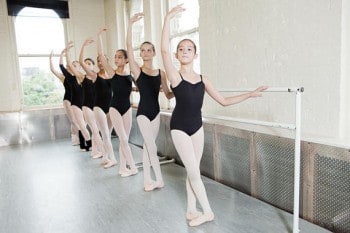
Many schools have a dress code. Quite a few require pink tights. This sounds easy enough, but there can be many variations: students are clever at turning a rule on its head by changing it enough to say they are following the rules, when actually they are not. You need to know if pink tights means footed, or if transitional tights, stirrup tights, or footless tights are acceptable. Sometimes a student will have on transitional tights—which, when worn over the toes are considered footed—and have them rolled up to mid-calf. When it comes to class, pink can probably encompass ballet pink, classical pink, light pink, or European pink. (Or, as it was in my case as a kid, white tights dyed into a pink that came from red food coloring!) For performances, most teachers will be painfully specific about what color pink they want and if they want the tights to be mesh, seamed, or seamless; supplex, cotton, nylon, or a combination of fabrics; Capezio, Bloch, or Danskin. To make it a lot easier, some teachers will tell you a style number to be sure you get exactly the right thing. The Danskin mesh seamed tight in style 32 is very popular, for example.

Along with tights, some schools will require that you wear a specific color leotard or a specific style: camisole, tank, short sleeve, or long sleeve. A lot of schools will not be too picky about style as long as you wear the correct color, or a solid color. Make sure you are wearing shoes that are acceptable as well. Usually this is left to the discretion of the dancer, but some teachers don’t particularly care for canvas over leather, for instance. Some want you to have a full sole rather than a split sole. Just be certain you know if there’s a preference, and make sure your shoes have the elastics sewn securely. Elastics that are tied behind the ankle or kept on with paper clips or safety pins are irritating to most teachers. You’ve been warned.

Hair and jewelry are biggies in ballet class. To be safe, I would say to put your hair in a bun with a hair net and plenty of hair pins and hairspray, and don’t wear any jewelry at all. Here again, there will be variations of what is acceptable at your particular school. You may be allowed to wear your hair clipped with a great big barrette so it doesn’t flop at all when turning, and it might be fine to wear earrings as long as they don’t dangle. Sometimes earrings that slip through without a catch at the back can fly out during grand allegro or turns across the floor, so use good judgment here. Click here to see a great video by dancers at the Anaheim Ballet on how to make hair buns. And a fun place to find ballet needs is at bunheads.com. For hair accessories, click here.

Finally, we come to the behavior that is expected in class.

  1. No talking unless you have a question for the teacher (and questions are normally very welcome, especially in beginning to intermediate levels). This includes any kind of communication with others in class, so no miming or eye-rolling either!
  2. Do not chew gum, eat, or drink during class. Sometimes you may be permitted to get a drink between barre and center, but it’s typically best not to leave the room to do so.
  3. Do not arrive late. If you arrive during the plié combination you can usually catch up. Otherwise you need to check with the teacher to see if it’s okay for you to join or if they prefer that you just observe class.
  4. Do not yawn.
  5. Do not get impatient with yourself—this can be misinterpreted by the teacher who thinks you don’t care for their class or combination.
  6. If you have an injury prior to class, let the teacher know that you may not do everything full out.
  7. If you get injured during class or pull a muscle, let the teacher know. Get ice, if possible, and watch the rest of class from the sidelines.
  8. Do not always stand in front. Take turns.
  9. Do not always go first across the floor unless the teacher asks you to.
  10. Do your best and have a positive attitude.

I encourage readers to add to the list if you can think of others I omitted. Of course, cells phones and ipods are also not good to bring into class. A few pet peeves of mine when I was teaching included students who had to go to the bathroom (although there might be exceptions, just don’t do this every single class), students who wanted to teach the class or recommend steps, and students who wore sweats over their tights once class began. Again, if you have an injury and you need to wear extra clothing for warmth, get permission from the teacher prior to class.

The nicest thing about class is the end. I always thought it very appropriate when I was dancing that we would let the teacher know we appreciated class by applauding at the end. Some teachers will tell young dancers that they should “give themselves a hand” so they get into the habit of clapping after class, but I believe that this part of ballet etiquette is more a show of respect for the authority and guidance of the teacher.


How to Pick Up Combinations Quickly

Posted by on Tuesday, 7 July, 2009

I was reading someone’s blog the other day, and one of the comments was from a young dancer who was having trouble remembering combinations in ballet class. I thought this would make a great blog post because I, too, was one of those dancers who stood in the back and tried to blend in. Eventually I became one of the quickest to pick up combinations and was no longer afraid to stand in the first spot at the barre or go with the first group in the center. Here are some of my ideas about how you can pick up combinations quickly.

Probably the hardest part for me was just learning all the steps…period. When I started dancing at Butler University as a high school student, I encountered so many steps I’d never seen before. Learning the basic mechanics of faille, temps le cuisse, ballonné, flic-flacs, brisé, entrechat trois (to name a few) took some time. It’s all part of the learning process, and until you are familiar with how to do each of the steps then you can’t be too impatient with yourself.

Once you’ve mastered the basics and you at least know how to do all the steps in a given combination, then you can begin putting things together. I found the single most valuable way to learn how teachers put combinations together is to begin recording them in a notebook. Now, when you first start doing this you will not be able to recall every combination from class; begin slowly and jot down one or two barre combinations that you remember and one or two center combinations.

As a prospective teacher yourself, you can always refer back to these one day and reuse them in your own classes. To make the most out of this exercise, here are the pieces you should note.

Type of combination

Teacher’s name and date

Time signature and beginning position

Counts and Steps

An example would be as follows:

Pointe Center Petit Allegro

Melissa Lowe 3-25-1987

2/4 Begin R foot front 5th croisé

1-2 Echappé to 2nd position en pointe, close L foot front 5th croisé

3-4 Detourné toward back foot, tombé front onto R

5 Step coupé back onto L

6 Pas de chat R to end L foot front 5th

7-8 Sous-sus L foot front, plié croisé devant

1-8 Repeat all to other side

Over time you will begin to notice how a particular teacher structures his or her classes, and how they structure the individual combinations or exercises. I tried to always stand behind someone at the barre that I could count on to know the steps, and in the center I did my best to be in the second group of dancers so I’d have time to watch the first group and review the steps. For petit allegro, sometimes just marking things with my hands was helpful, or making up a cadence to say in my mind that would help me know what came next. For the combination above, I might have made something up that went in time with the musicality or counts: out, in, turn, step front, coupé, pas de chat and up and down.

Learning to switch feet quickly, where to place your weight, which foot closes front or back, how to reverse a combination—all of this takes time to accomplish. Besides writing down the combinations, it can also be helpful to go over them in your mind while your body is actually at rest. Much of this is a mental task anyway, so wearing yourself out and tripping over your feet might not be the most efficient way to learn how to pick up steps faster.

Knowing that you are going to need to recall a certain combination after class in order to jot it down in your notebook will help your long term memory. You’ll be amazed at how many steps are commonly linked together in the same pattern. Also, if you memorize the sequence of steps, you’ll be able to do them at a much faster rate in your head than you could do with your body. When I was learning lines for a play, for example, I would always try to say them as fast as I could just so I knew that I had them down; I never intended to perform them aloud at the same pace, but it boosted my confidence if I could say them quickly. The same thing applies with combinations: you can fast forward the time signature and watch it in your head at a very quick rate, so when it comes time to do a similar combination in class you’ll be more prepared to tackle it at the right tempo.

Do any other dancers out there have tips for how to pick up combinations? A lot of it is just perseverance and not giving up. Each day your brain is putting two and two together and before you know it things will begin falling in place.


  • Facebook

    Ballet Combinations on Facebook
  • Inside Ballet Technique

    ↑ Grab this Headline Animator

    Business Directory for Cornelius, North Carolina Inside Ballet Technique - Blogged submitgooglesitemap.com Sitemap Generator Bloglisting.net - The internets fastest growing blog directory Performance Art Blogs - BlogCatalog Blog Directory Inside Ballet Technique at Blogged
  • Meta

  • Flags

    free counters
  • Enhanced with Snapshots
  • Get Adobe Flash playerPlugin by wpburn.com wordpress themes